Solace had been working with AARP through digital placements, run-of-site display and social promoted on AARP's platform. Engagement was strong. Conversion efficiency was not.
Healthcare advocacy is a category most people have never heard of, and a display unit is not big enough to explain one. The formats were the constraint, not the audience.
What I did
I wrote the brief for a full-page test in AARP The Magazine, which reaches about 19.5 million readers nationally. Rather than buy nationally, we tested the Mid-Atlantic edition, roughly 2.6 million member households, chosen for provider coverage and active patient populations. Print bought us the space to introduce the category instead of assuming it.
2.6Mmember households in the test edition
19.5MAARP The Magazine readership
50+audience the layout was built for
Then the first round came back
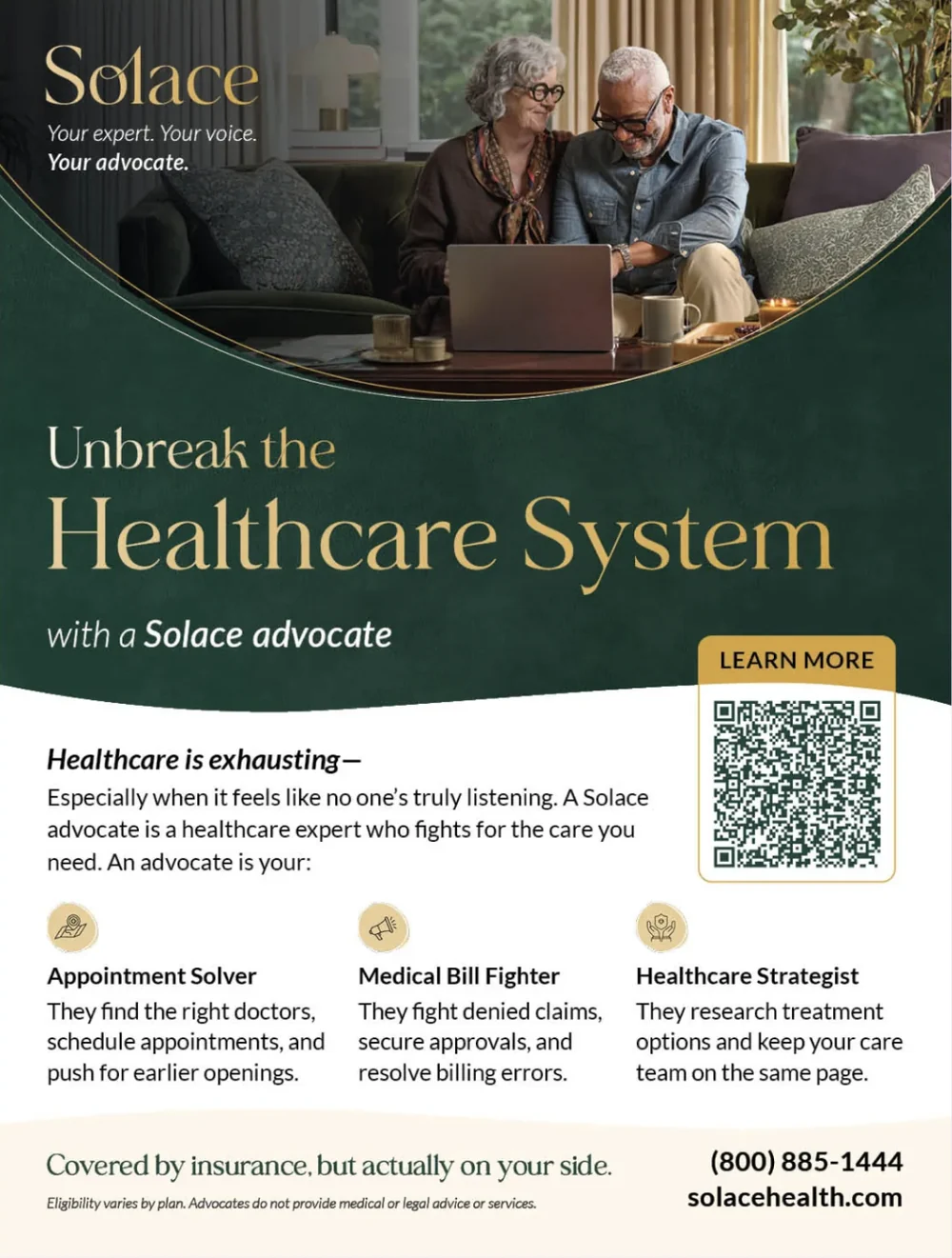
Version one was built on fighting language. Unbreak the Healthcare System. An advocate who fights for the care you need. Three pillars named Appointment Solver, Medical Bill Fighter, and Healthcare Strategist.
By that point I had been running patient interviews through our qualitative program, and three findings pointed the other way.
Patients who had any idea what an advocate was expected a fight. What they valued was the opposite: someone who knew how to work the system without turning every call into a battle.
Patients never describe the category. They describe one specific problem. "I needed my doctor to call me back." "I needed help with my insurance." Nobody goes looking for an advocate.
Financial fear came up again and again, and cost was a deciding factor in whether people moved forward.
What changed in version two
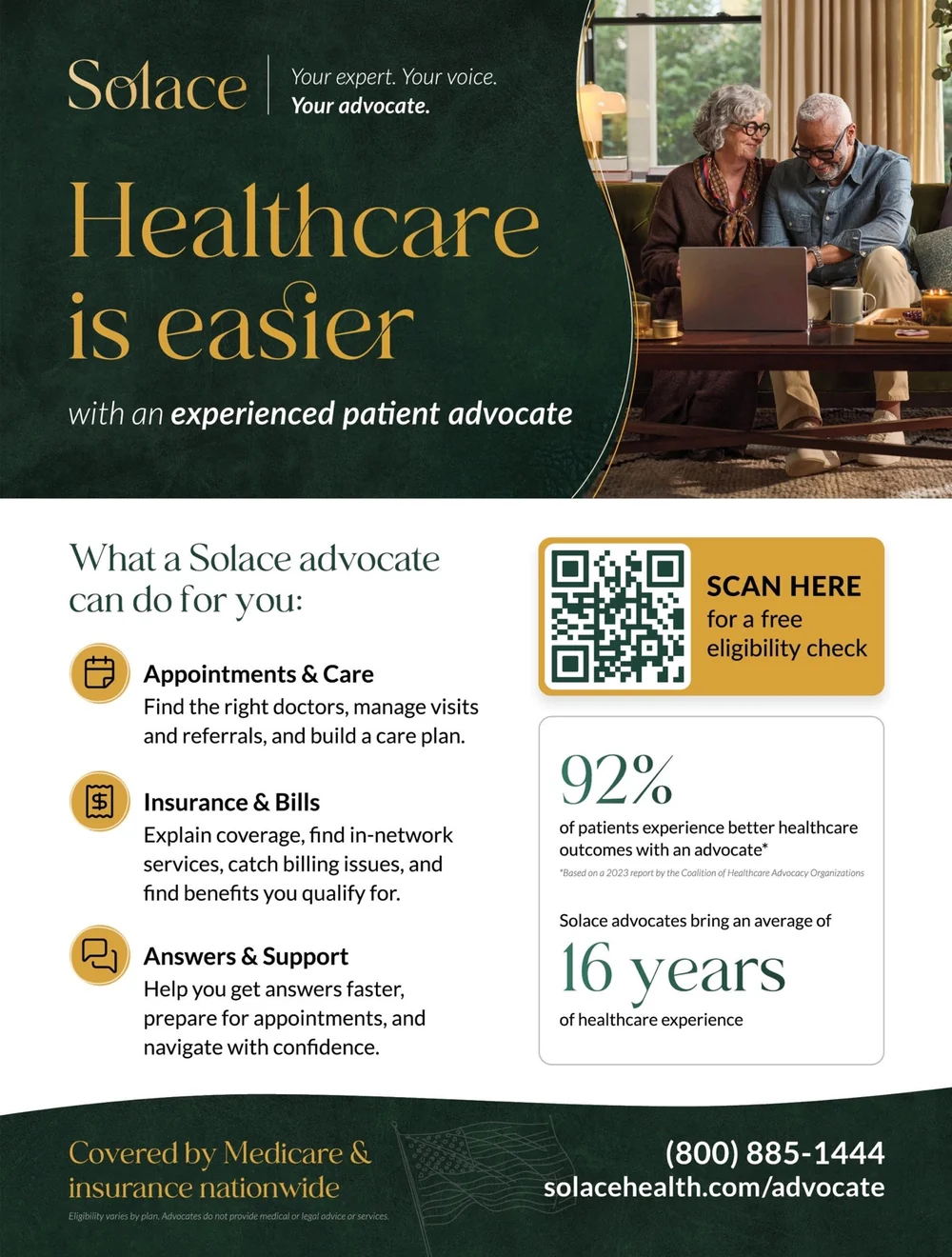
Headline moved from the problem to the outcome. "Unbreak the Healthcare System" became "Healthcare is easier."
Combat framing came out entirely, including the word fighter.
The three pillars were renamed from invented job titles to the problems patients actually name: Appointments & Care, Insurance & Bills, Answers & Support.
Coverage language moved up and got specific. "Covered by insurance" became "Covered by Medicare & insurance nationwide," which names the audience and removes a geographic objection in the same line.
The call to action went from vague to concrete and free. "Learn more" became "Scan here for a free eligibility check," which is also the real first step of the funnel rather than a generic invitation.
Third-party proof was added for a category readers had never encountered, alongside the advocates' average years of healthcare experience.
The landing path got deeper and trackable, so the placement could be measured rather than guessed at.
Version 1Version 2
Drag to compare. Version one on the left, version two on the right.
Worth noting
The brief and the rewrite were the same job. Writing the brief is what put me in the room for the creative review, and the interviews are what gave me something to say when the first round did not fit.
Solace Health · Qualitative research
Running the research behind the messaging
InsightsBrand
The problem
The team had performance data and very little language. Every conversation with a patient or an advocate contained something that could sharpen the messaging, and none of it was being captured anywhere a marketer could use it.
What I did
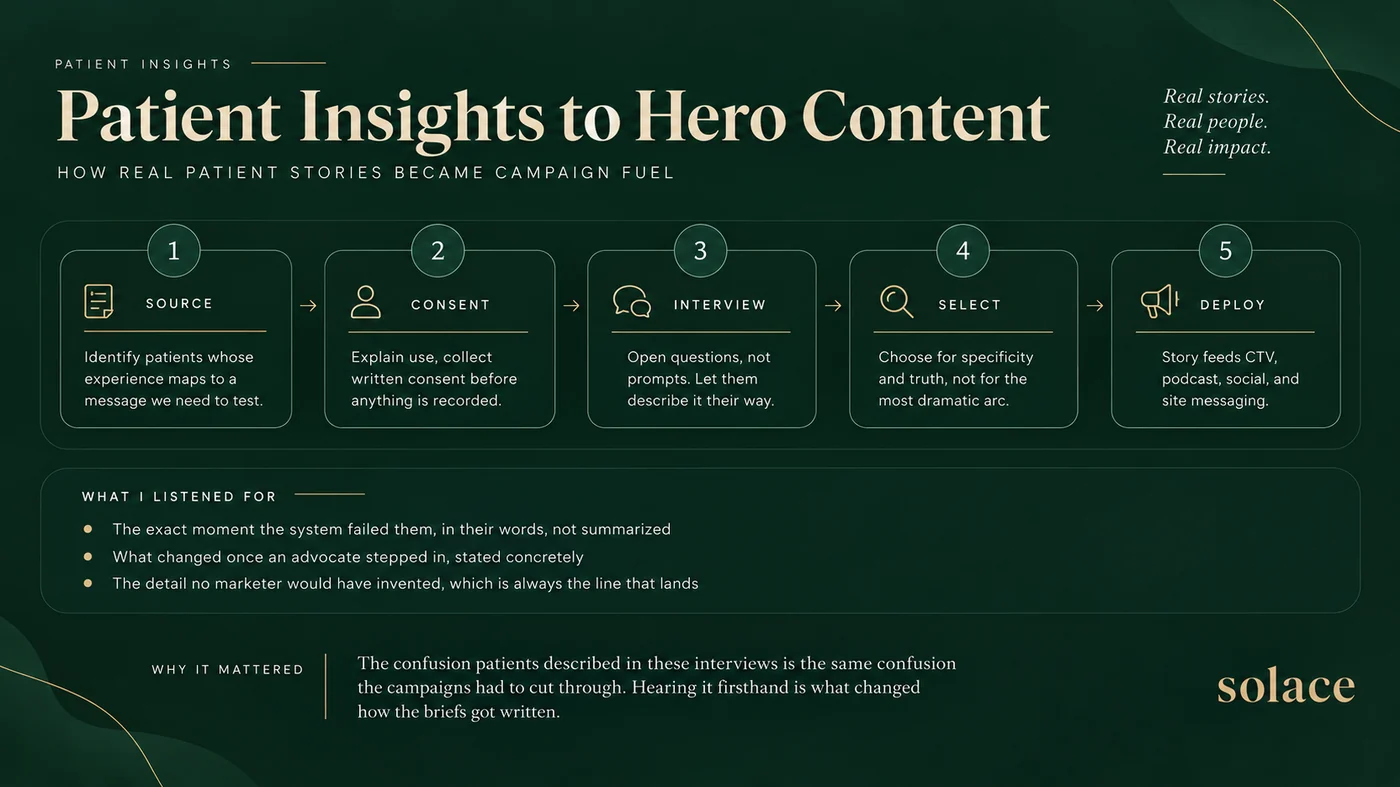
I maintained the Insights Hub, Solace's qualitative research program, and led the messaging and audience insights workstream inside it. I designed the questionnaires, interviewed patients and advocates, and built consent into the process from the start so the stories could be used in marketing rather than sitting in a research folder.
Findings went to Performance, Lifecycle, Creative, Advocate, Product, and Clinical Operations, which meant writing them up differently depending on who needed to act on them.
The path from a patient conversation to a campaign asset, including where consent sits.
Some of what came out of it
Patients describe one specific problem, never the category. The word advocate only appears afterward, as a name for what already happened.
They say their advocate works for them, not for a hospital or an insurer. It is "someone finally on my side," not "someone finally organized."
The gap is not a lack of sympathy. Several patients had already tried an advocate through a hospital or their own insurance plan and got a sympathetic phone call with no follow-through.
Trust comes from speed and one concrete win, not from credentials or polish. A callback the same day. A doctor found within 24 hours.
The trigger is rarely one bad day. It is the last straw after months of being stuck.
Where it went
Straight into the work. The AARP print rewrite came directly out of these interviews, as did the direction for new CTV creative and the briefs that followed. I also built the hero story one-pagers and the production proposal for filming patient stories on camera, which meant sourcing the patients, arranging releases, and writing the pre-production briefs.
This is the part of the job I want more of: being close enough to the audience that the creative argument is already settled before the review.
Solace Health · CTV, podcast, audio
Taking a healthcare brand into channels it had never used
BrandOfflineDigital
Context
Solace was running on Meta and Google. As audience targeting widened from Medicare to commercial insurance, the brand expanded into four channels it had never used: connected TV, podcast, influencer, and streaming audio.
I worked on the brand side of that expansion, closely with the performance team, who owned media buying and budget.
What I did
Wrote and co-wrote the creative briefs, including condition-specific CTV videos for commercial audiences, the podcast host-read guides, and a 20-card evergreen art card library.
Served as guardian of brand voice and final approver on every asset before launch, partnering with Legal and Clinical on compliant healthcare messaging.
Supported the podcast program's growth from one partner to four networks: SiriusXM, iHeart, The Ramsey Show, and Red Seat Ventures. Partners were chosen strategically to reach audiences the healthcare system underserves, prioritizing host-read placements alongside talent partnerships including Keke Palmer.
Contributed to monthly creative insight readouts for CTV and podcast performance, and set up UTM tracking and naming conventions so campaign results were measured consistently across channels.
4new acquisition channels
1 → 4podcast networks
20%team MoM revenue growth contributed to
What the expansion produced
Comparing the period before the expansion with the period after, across the blended program and the two new offline channels. Figures are shown as change rather than absolute cost, since the underlying numbers are internal.
~3xweekly bookings, blended
-26%blended cost per booking
-20%CTV cost per booking
2.6xpodcast bookings
-69%podcast cost per booking
The creative learning
We ran advocate-led and patient-led versions of the CTV creative. Patient-led storytelling outperformed advocate-only spots and became the default approach for new CTV work. It lines up with what the interviews said: patients describe their own specific problem, and hearing someone name that problem does more than hearing a professional describe a service.
Patient-led spot. A patient telling his own story.
Advocate-led spot, edited for commercial audiences. Same offer, different narrator.
Solace Health · Process design
Building the process for high-profile partnerships
Project mgmtInfluencerBrand
The challenge
Public figures and creators were coming through media and influencer partnerships to use the product themselves, and each one was being handled ad hoc. When a partner's own experience is the marketing asset, a bad hand-off costs more than the partnership fee. It costs the endorsement.
What I did
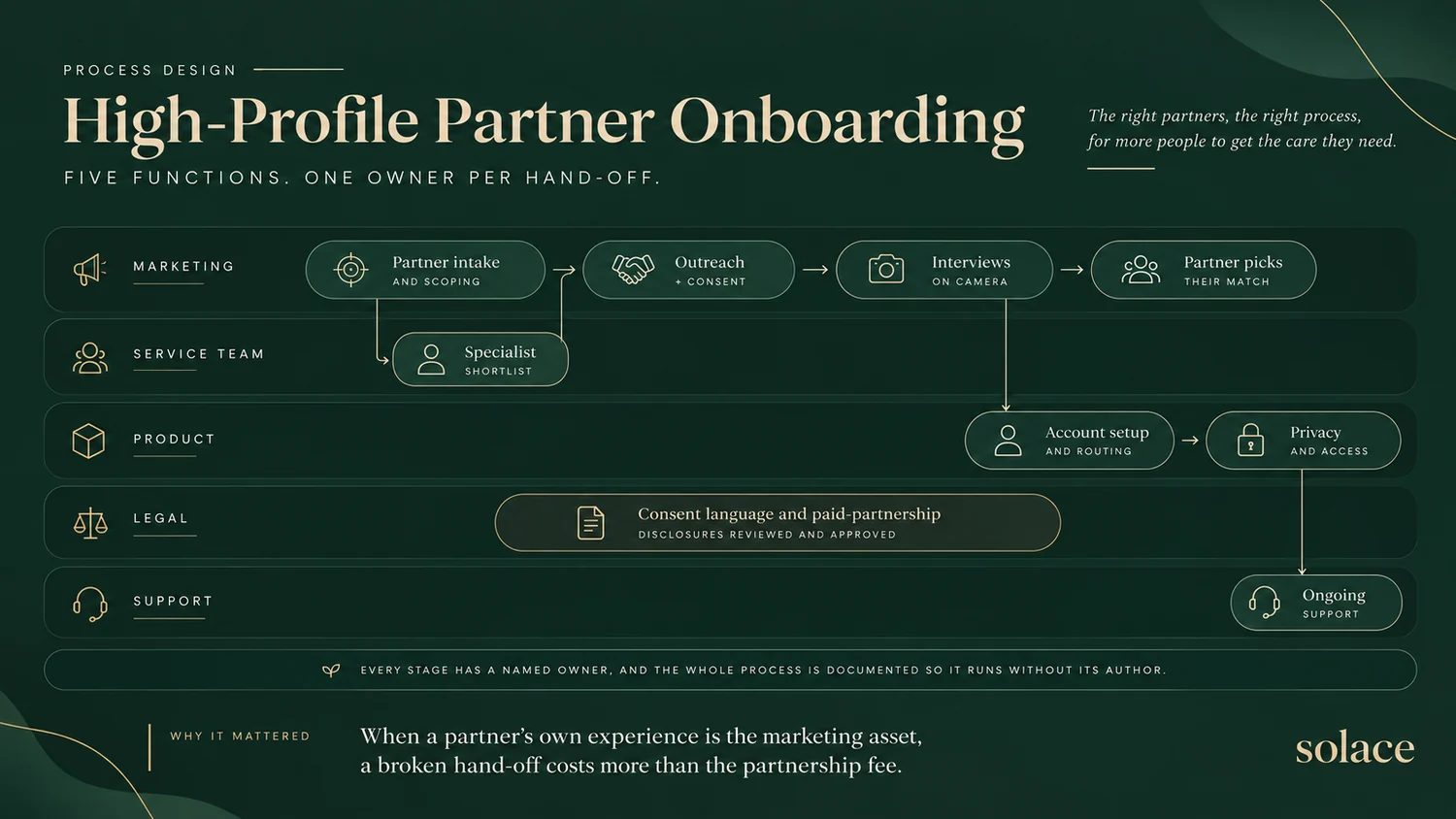
I mapped where the standard patient journey would break for these partners, then worked through every hand-off with the function that owned it: the service side for matching and vetting, product for account setup and access, legal for consent and paid-partnership disclosure language, and support for the relationship afterward.
I designed the workflow stage by stage with a named owner at every step, built a three-tier structure that capped advocate hours and marketing spend per tier, set up a partner tracking database, and documented the whole thing as an SOP so the program could run without me. Partners included Keke Palmer.
5functions coordinated
3tiers with capped hours and spend
1named owner per hand-off
The result
A repeatable onboarding path for high-visibility partnerships, with privacy and legal guardrails built in rather than patched on. Product added a scalable version of it to the Q4 roadmap.
Hyatt Inclusive Collection · Creator campaign
A creator launch across three markets
InfluencerBrandProject mgmt
The brief
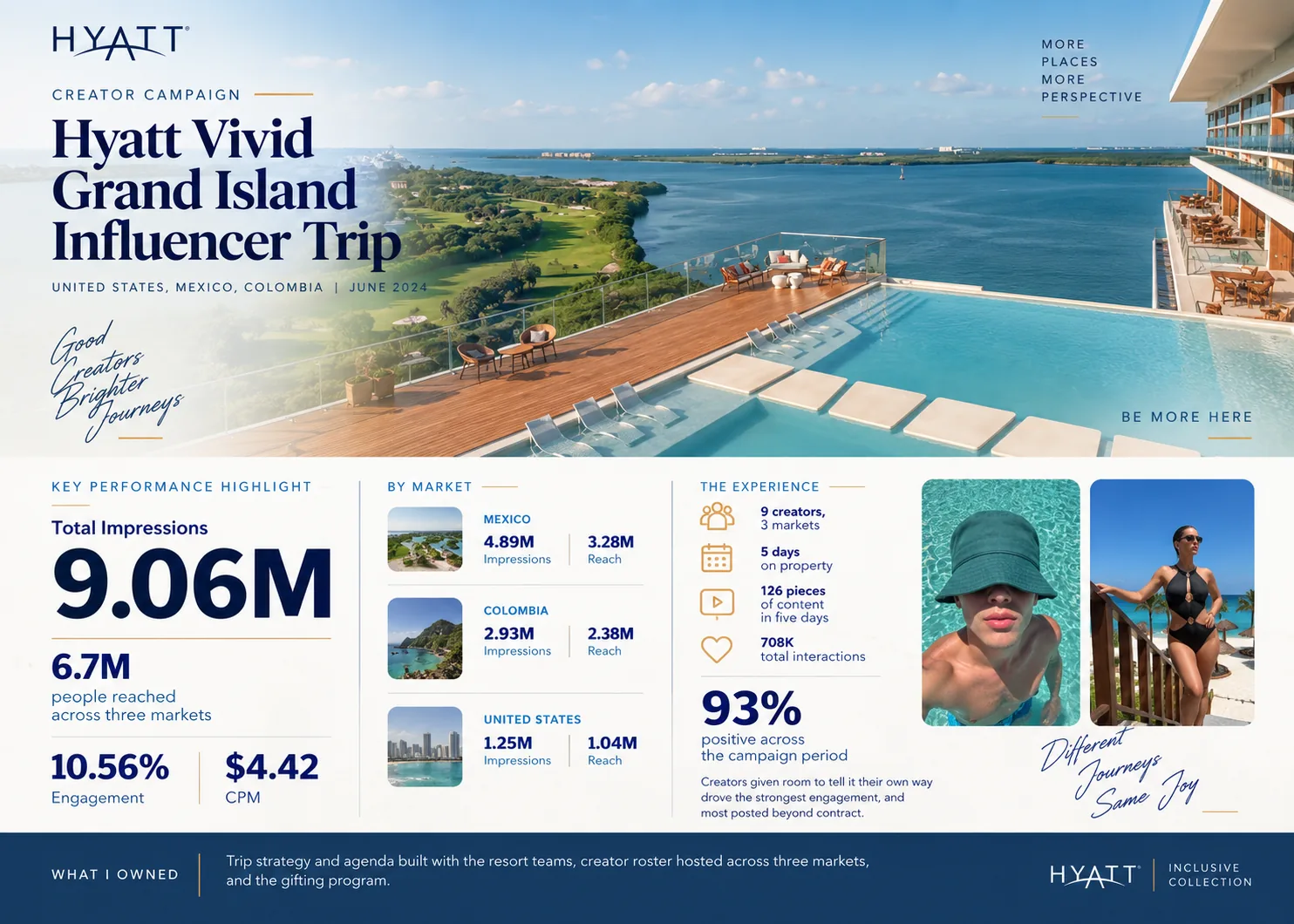
Launch Hyatt Vivid Grand Island, a new adults-only brand, with creators from the United States, Mexico, and Colombia on property at the same time. One property, three markets, three sets of audience expectations, five days.
What I owned
Trip strategy and the daily agenda, built with the resort teams so the content moments and the hotel's operating reality agreed with each other. The creator roster across all three markets, the gifting program, and how the brand showed up on property while they were there.
9.1Mtotal impressions
6.7Mpeople reached
10.6%engagement rate
126pieces of content in five days
93%positive sentiment
$4.42CPM
What I took from it
The creators given the most room to tell it their own way drove the strongest engagement, and several posted beyond what their contracts required. Nine creators in three markets is a logistics problem on paper, but the thing that actually decided the output was how much we scripted them.
Hyatt Inclusive Collection · Regional campaign
Diagnosing an underperforming market
DigitalBrand
The problem
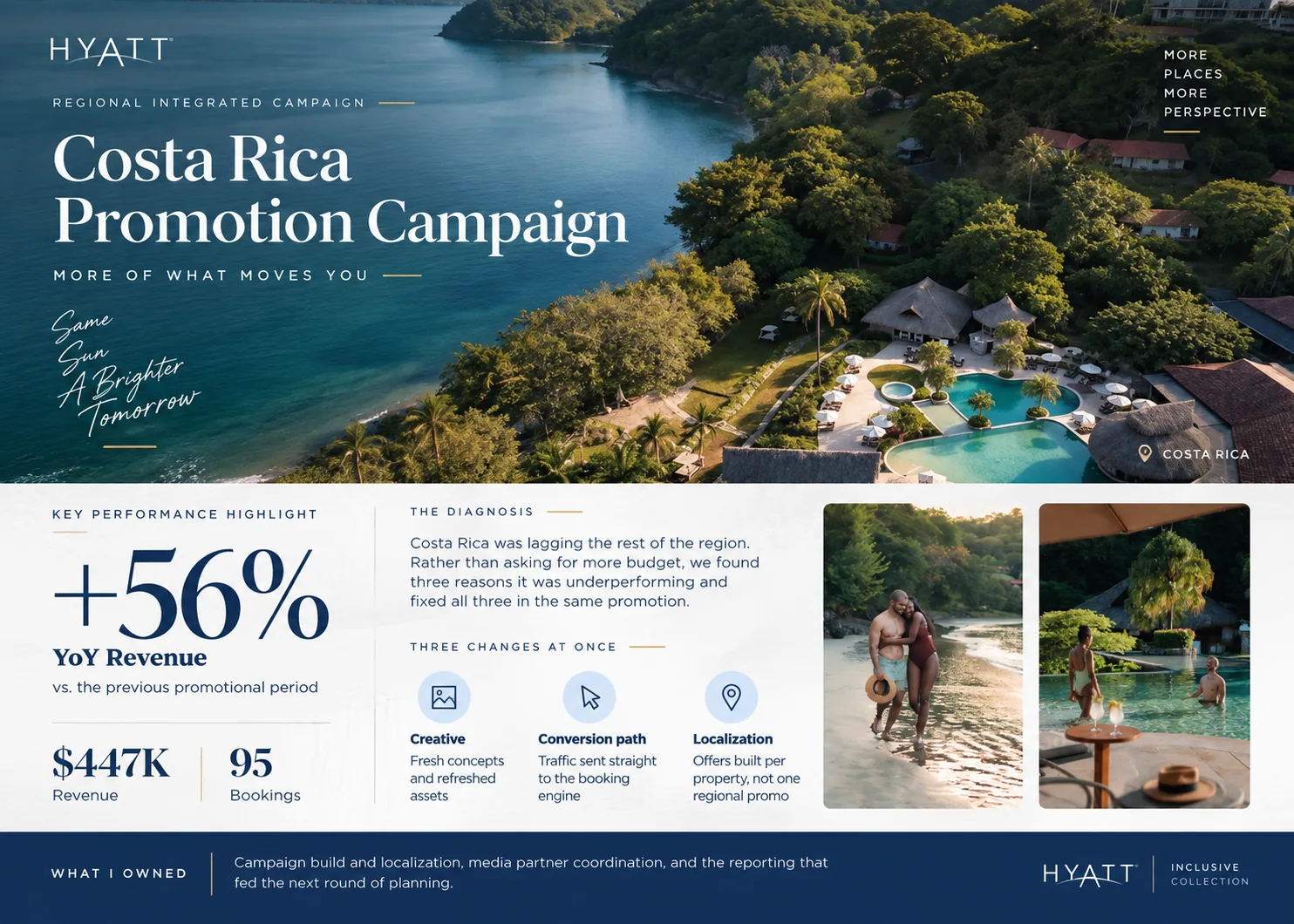
Costa Rica was lagging the rest of the region. The easy answer was to ask for more budget. Instead I went looking for why.
Three things were wrong at once
Creative was stale. Same audience, same assets, running too long.
The conversion path had an extra step. Traffic was landing on a general page rather than the booking engine.
The offer was regional, not local. Guanacaste was folded into one promotion covering properties it had nothing in common with.
I rebuilt the promotion around all three: fresh concepts and refreshed assets, traffic sent straight to the booking engine, and offers built per property so each one was priced and positioned on its own terms.
+56%campaign-attributed revenue
$447Krevenue generated
95bookings
What I owned
Campaign build and localization, media partner coordination, and the reporting that fed the next round of planning.
Hyatt Inclusive Collection · Integrated campaign
Llena Tu Memoria de Recuerdos
BrandDigitalLifecycle
The campaign
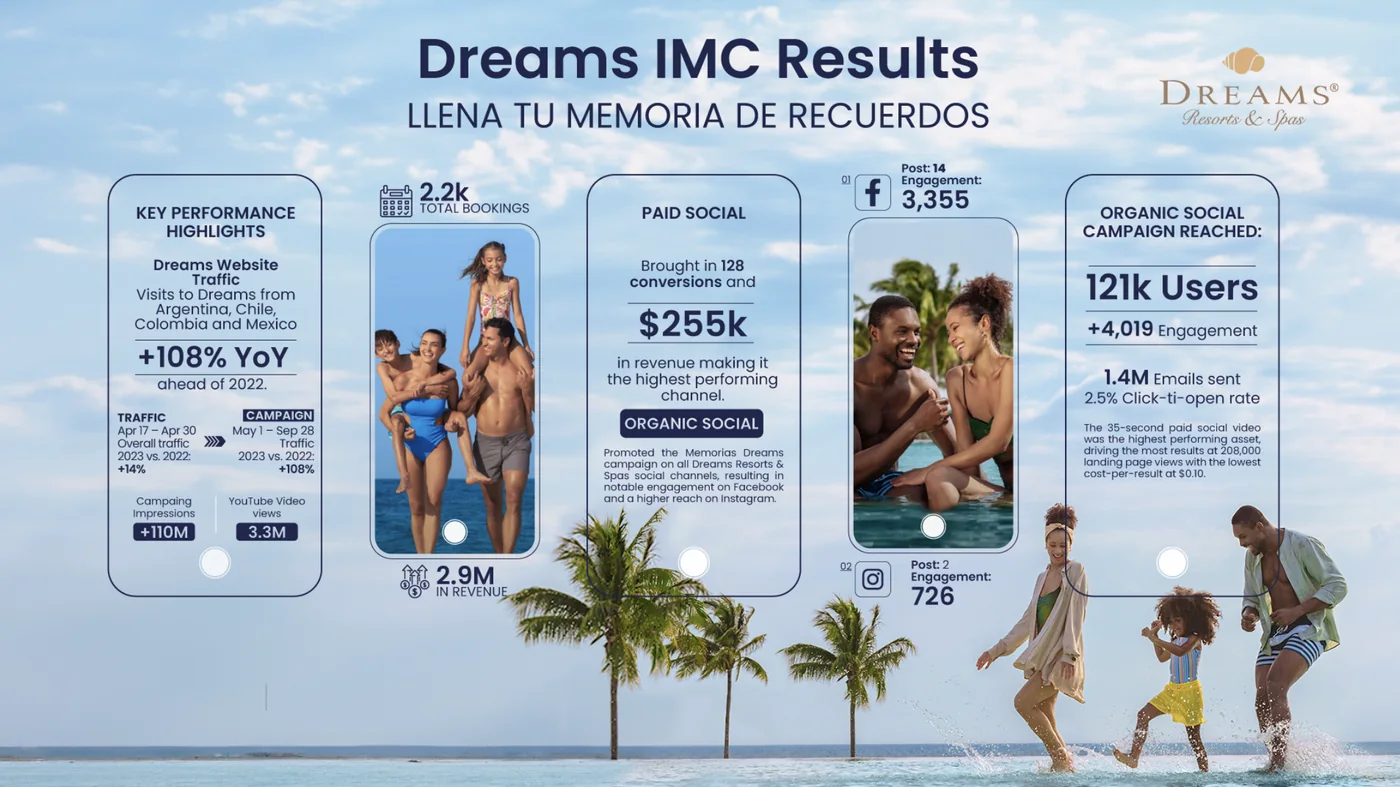
An integrated campaign for Dreams Resorts & Spas, built and localized in Spanish for Argentina, Chile, Colombia, and Mexico, running across web, paid social, organic social, email, and YouTube.
I supported it as an intern through execution, then carried it into my associate role. Each market got its own Spanish rather than one translated version, which is most of the reason it travelled as well as it did.
$2.9Mrevenue
2.2Kbookings
+108%YoY website traffic
110M+impressions
3.3MYouTube views
1.4Memail sends at 2.5% click-to-open
My part
Localization and review of scripts for radio, television, PR partners, and hotels across LATAM and Mexico. Monthly social content calendar audits with the regional and creative teams. Keeping brand voice consistent across four markets that each wanted to say it slightly differently.
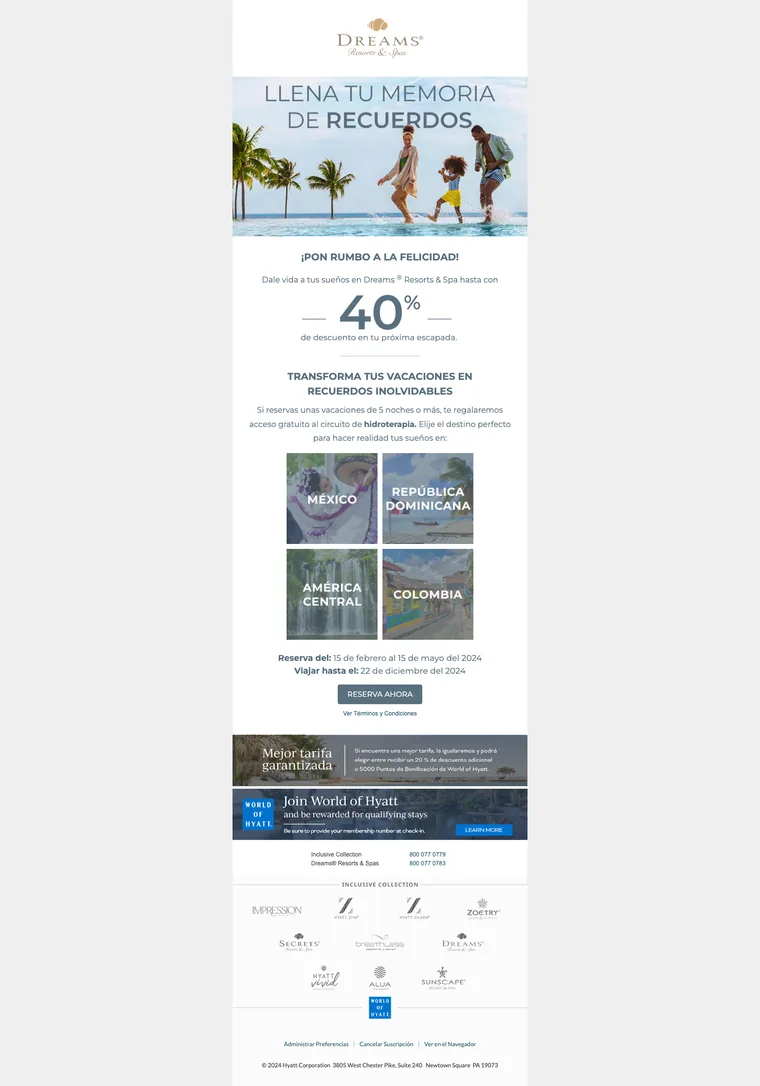
Llena Tu Memoria de RecuerdosThe campaign email, built for four markets.
Hover an email to scroll it.
Hyatt Inclusive Collection · Lifecycle
Fixing a calendar that kept missing its own launches
LifecycleProject mgmt
The problem
Mexico promotional emails were shipping late or not at all, and attributed revenue was close to zero. The campaigns existed, the offers existed, the creative existed. What did not exist was an agreed order of operations, so every month rediscovered the same bottlenecks.
What I did
Built a standardized SOP covering every stage from offer decision through creative, localization, QA, and send, with a named owner and a real deadline at each one.
Moved send timing to align with Mexican paydays rather than the convenience of the marketing calendar.
Coordinated Revenue, Distribution, Brand, Creative, and Email through a single decision point instead of parallel conversations.
Wrote each market its own Spanish instead of translating one version across all of them.
$50Kper campaign at peak, from near zero
25campaigns shipped across the calendar
9resort brands covered
The wider job
I owned the promotional email calendar for the Mexico, LATAM, and U.S. markets, planning and executing five or more integrated promotional and seasonal campaigns a month across nine resort brands. Each one shipped with an offer in Spanish and English plus digital, social, and paid support, and I owned the reporting that fed the next round of planning.
A/B testing along the way turned up something I reused: talent-led hero images outperformed product imagery, so later promotions led with people.
A few from the calendar
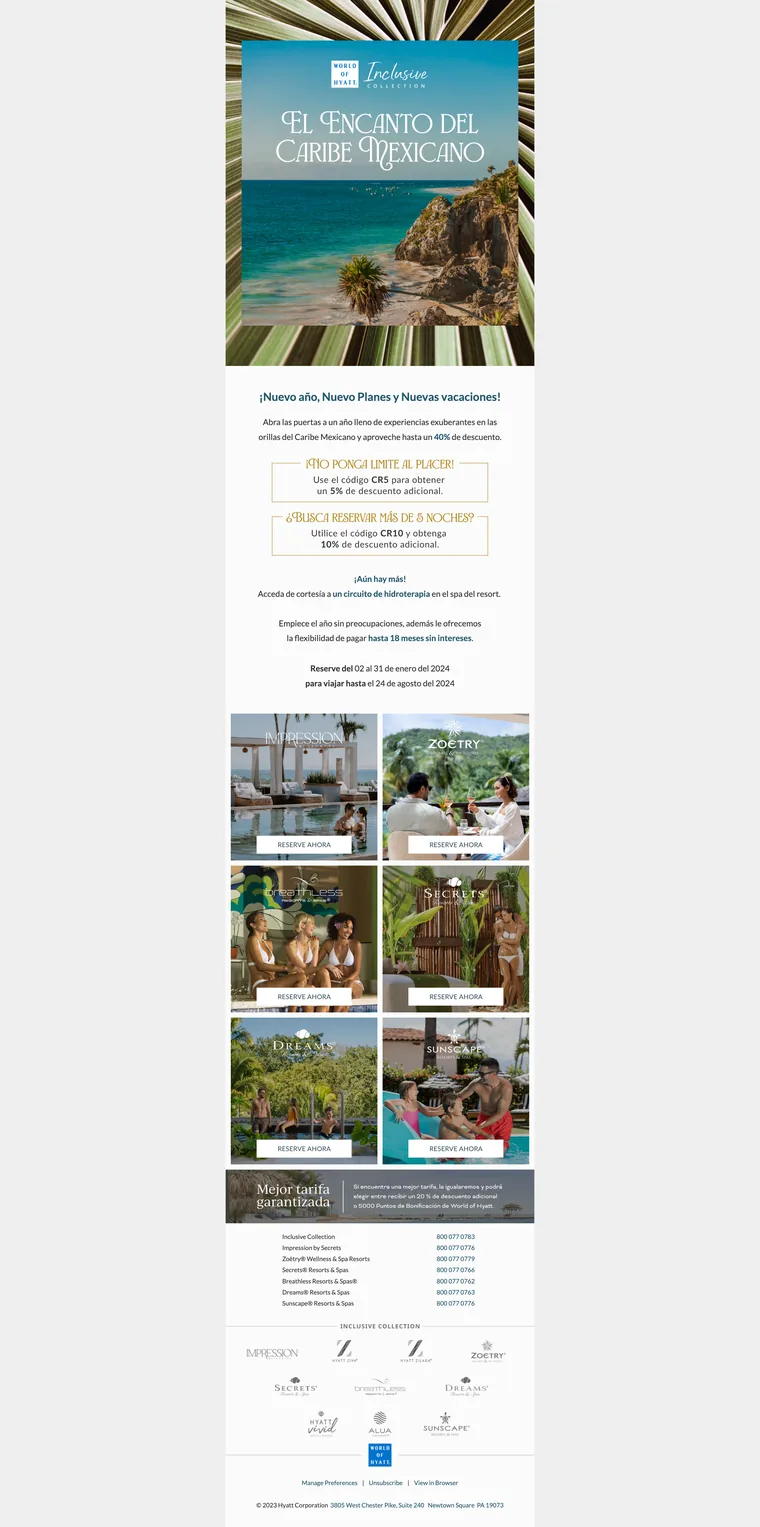
Each one carried its own offer, its own creative, and its own Spanish. Hover to scroll an email.
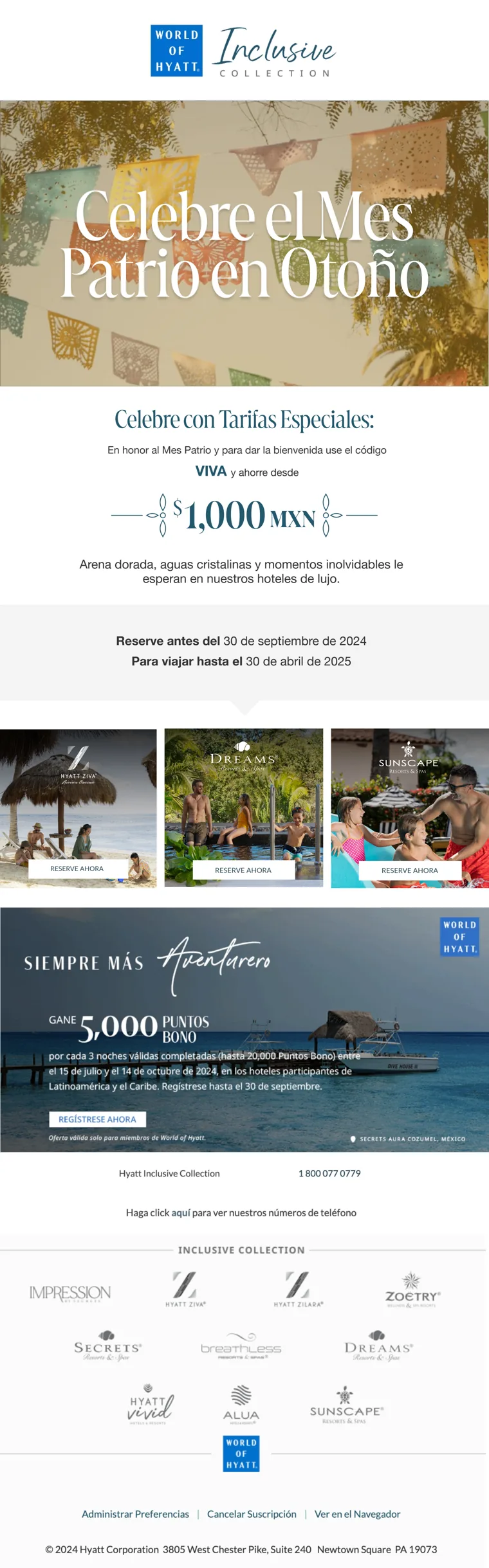
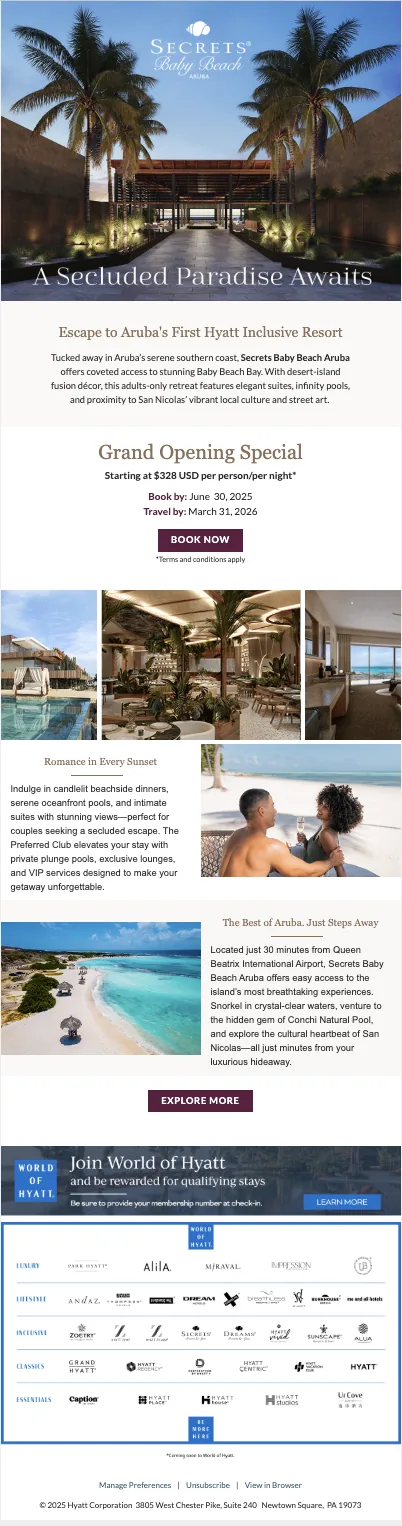
El Encanto del Caribe MexicanoJan 2024 · stacked offer codesDescubre La Magia De NoviembreNov 2023 · length-of-stay offerCelebre el Mes PatrioSep 2024 · built for a Mexican holidaySecrets Baby Beach ArubaGrand opening · English market
Why the Mes Patrio one matters
It is priced in pesos and built around Mexican Independence month. That is the difference between a localized campaign and a translated one: the offer, the timing, and the reason to book all come from the market rather than from headquarters.
Hyatt Inclusive Collection · Production
Producing on property, guarding the brand on set
BrandProject mgmtOffline
What I did
Acted as producer and project manager on property across more than ten openings, reopenings, and rebrandings, covering television productions, photoshoots, and brand films. That meant building the shot list and schedule with the resort teams, coordinating crew, talent, and hotel operations across departments, keeping the shoot moving against a fixed window, and acting as the guardian of brand guidelines on set.
The opening productions included Secrets Mirabel in Mexico and the opening shoot for Secrets Playa Mujeres, which produced both the photography library and the brand film below.
Why it mattered
On a shoot day, brand standards are enforced in real time or not at all. Whether a room was styled correctly, how food and beverage appeared on camera, whether the talent direction matched the brand's tone: once the crew leaves the property, whatever was captured is what the brand has to live with for the next two years.
Secrets Mirabel, from the opening shoot
A few frames from the library the production delivered. Every one of these had a styling decision behind it that someone had to make on the day, and defend.
Secrets Playa Mujeres, cut from the opening shoot.
Activations and sponsorships
Alongside production I led activations across the region: Rodando por una Sonrisa in Colombia, a nearly 1,000 km charity ride funding cleft palate surgeries for children with Hyatt as a main sponsor, where I project managed the logistics and hosted the press conference that aired on national television. Also the UNICEF 10K in Buenos Aires for Sunscape with 5,000 runners, branded Cinemark Colombia placements timed to major film releases, LGBTQ safe-tourism campaigns across Argentina, Chile, and Colombia, and family-brand mall pop-ups in Mexico.
I managed sponsored placements with NTN24, an international Spanish-language news network broadcasting across 25 countries, alongside RCN and Radiópolis on Colombian national television and radio. The work covered Dreams, Secrets, Sunscape, Breathless, and Hyatt Vivid.
My part was reviewing and approving scripts for tone of voice, supporting production on site, and handling the coordination between the network, the agency, and the resort teams.
What it became
The placements worked well enough that NTN24 built a format around them. Destino Exclusivo, a recurring segment inside the channel's Flash Fashion programme, created specifically to cover Hyatt properties.
Each destination gets a full week on air with presenter Santiago Giraldo: six organic segments of at least four minutes each, two interviews with hotel spokespeople, and a featured destination piece, running on television and across the channel's own social accounts. Gastronomy, lifestyle, and destination are the three pillars.
That is the difference between buying airtime and becoming programming. A paid spot ends when the flight ends. A format the network owns keeps coming back, and the audience meets the brand as editorial rather than as an advertisement.
A Flash Fashion segment, produced on property.
The alliance across 2024 and 2025
Los Cabos, November 2024. 1,059,683 views.
Cancún, February 2025. 742,162 views.
Curaçao, May 2025. 813,489 views.
Dreams Curaçao digital, June to July 2025. 1,464,396 views against a 900,000 target, and 24,947 clicks.
Jamaica, July 2025, in flight at the time of the last report.
4.08Mtotal digital views
4.8Madded TV audience
25countries reached
24.9Kclicks
7.5Kinteractions
+63%over target on the digital campaign
Worth noting
The format earned recognition for the network both nationally and internationally, and every campaign delivered more posts than were contracted. I also negotiated preferential terms on the alliance, including exclusive terms on the format itself and on crew.